Introduction
Effective asset management is strategically important in delivering an efficient and sustainable approach to maintaining our highway infrastructure assets. Through long term planning, it ensures that standards are clearly defined, achievable and aligned with available budgets. Asset management also provides robust, evidence based data to support funding bids and improve communication with stakeholders, helping to demonstrate the contribution that highway infrastructure assets make to economic growth and to meeting the needs of local communities.
At over 9,000km in length, North Yorkshire has one of the longest road networks of any highway authority in the country. The current annual maintenance budget (for both capital and revenue) is circa £95m and as such it is vital to ensure that we achieve the best value for money for its taxpayers and delivers the best possible outcomes for all users of the highway network.
Our highways and transportation service utilises a range of asset specific management programmes to support the effective delivery of all highway services. These provide a risk based, data led approach to both planned and reactive maintenance, incorporating asset deterioration modelling and long term forecasting to inform works programming. The approach is underpinned by strong stakeholder engagement to ensure investment decisions are well understood and appropriately targeted.
This document represents a revision of the strategy to reflect the following:
- several updated strategic council documents; local transport plan (York and North Yorkshire Combined Authority) and the highways infrastructure asset management policy
- updated guidance from Department for Transport; including the new PAS2161 data standard, the new Red, Amber and Green (RAG) ratings for carriageway condition reports and longer-term funding allocations
- changes to how highway maintenance funding is now allocated from the York and North Yorkshire Combined Authority
- knowledge gained from continuous improvement within the highway service
- implementation of the North Yorkshire lane rental scheme
North Yorkshire highways asset management framework
Our highways and transportation service has been implementing asset management in the highways maintenance service for a number of years, through an asset management framework. The framework represents North Yorkshire’s approach to asset-based highways maintenance; agreed by senior decision makers and its principles recorded through a series of related documents.
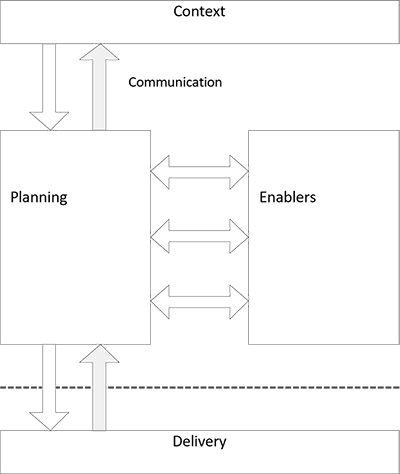
The framework follows the guidelines set down by the UKLRG, commissioned by DfT as part of the highways maintenance efficiency programme. It is tailored to the needs of the council. See the diagram below for an overview of the framework and the text below which describes the three main parts of the framework:
- Context – describes the context for highway infrastructure asset management, the organisation and the environment within which the local highway service is delivered.
- Planning – describes the key activities and processes for asset management planning and gives advice on how these should be applied to highway infrastructure assets.
- Enablers – describe the enablers that support the implementation of the asset management framework.
The remainder of this document will detail how the asset management framework assists in the delivery of the overall highways service.
Our context for highways infrastructure asset management
Strategic transport framework
With the establishment of the York and North Yorkshire Combined Authority, our asset management strategy will look to align with the objectives of the Combined Authority alongside our objectives.
Within the council plan 2026-2030, which sets out our vision for North Yorkshire, it recognises that there is a need to “maintain safe highways and advocate for increased funding for rural transport”
Informed by the strategic transport plan developed by Transport for the North, The Combined Authority’s strategic transport framework sets out the transport ambitions for the York and North Yorkshire and the steps to produce a full local transport plan whilst also helping the Combined Authority with prioritisation of future transport investment and activity.
The goal of the local transport plan is set by the Mayor’s vision (2024) as follows.
“…to make healthy and resilient communities, that are connected to opportunity, where people live in warm and affordable homes, where people are connected to the outdoors and where there are safe places for all”
The framework aligns with the Mayor’s vision (2024) and its five key transport objectives:
- to achieve healthier travel
- to make travel accessible for everyone
- to enhance safety
- to protect the environment
- support economic growth
The framework sets key objectives and themes which the highways service works on developing the local transport plan.
Local transport plan
A new local transport plan for York and North Yorkshire is being developed by the York and North Yorkshire Combined Authority with a final adopted local transport plan expected in late 2026 or early 2027. The emerging local transport plan takes the vision as set out by both councils and details a long-term approach to how we will deliver on the transportation elements.
Below is an excerpt from the draft local transport plan
…how the transport services and infrastructure provided by the council and partners aim to contribute towards our shared Vision and the joint York and North Yorkshire Combined Authority plan priorities
The development of the local transport plan for York and North Yorkshire will align the economic growth ambitions and help to unlock the long-term growth potential of the area. The local transport plan is closely aligns with the local growth plan (2025), the Mayor’s vision (2024), the economic framework (2024), the spatial development strategy (currently in development) and the draft strategy for a sustainable future (2026).
The main links between the emerging local transport plan and the Highway Infrastructure Asset Management strategy are:
Safety
Safety is the primary driver of highways asset management. The strategy prioritises investment based on asset condition, risk and network function, ensuring that defects and deterioration are identified and addressed before they present an unacceptable hazard to users. Through regular inspections, lifecycle planning and risk-based maintenance interventions, we seek to provide a safer network for all users, reducing the likelihood of accidents, service disruption and asset failures. Asset management also supports our statutory duties under the Highways Act and strengthens the authority's ability to demonstrate effective network management.
Accessibility and inclusive mobility
A well-maintained highway network improves accessibility by enabling people to travel safely and independently, regardless of age, ability or mode of transport. Asset management supports the provision of accessible footways, crossings, street lighting and highways infrastructure that help remove barriers to movement. By considering user needs within maintenance programmes and prioritisation processes, the strategy contributes to the local transport plan's objective of making travel accessible for everyone and ensuring communities remain connected to essential services, employment and social opportunities.
Environmental sustainability and climate resilience
The strategy supports the York and North Yorkshire local transport plan ambition to achieve carbon negative and improve environmental outcomes through more sustainable maintenance practices. Lifecycle planning enables us to prioritise preventative treatments that extend asset life, reduce material consumption and minimise the carbon impacts associated with reconstruction. In parallel, we continue to evaluate innovative materials, construction techniques and technologies that lower whole-life carbon emissions. Asset management also helps improve network resilience to climate change by identifying vulnerable assets and targeting investment to reduce the impacts of flooding, extreme weather and other climate-related risks.
Active travel and healthier communities
The quality and condition of highway assets play a significant role in encouraging walking, wheeling and cycling. Through the management of footways, drainage, street lighting and carriageway surfaces, the asset management approach supports safer and more attractive conditions for active travel. By maintaining infrastructure that supports sustainable travel choices, the strategy contributes to healthier lifestyles, reduced reliance on private vehicles and the delivery of the York and North Yorkshire local transport plan objective of achieving healthier travel. Asset condition data and investment programmes can also help identify opportunities to support future active travel improvements and integration with wider transport initiatives.
Economic development
The highway network is a critical enabler of economic activity across North Yorkshire. Effective asset management helps maintain reliable connections between businesses, markets, ports, rail facilities, tourist destinations and communities. By targeting investment where it delivers the greatest benefit and maintaining key strategic routes, we support productivity, reduces disruption caused by asset failures and improves journey reliability for residents and businesses. Long-term programming and evidence-based investment decisions also strengthen our ability to secure external funding that supports economic growth and infrastructure improvements.
Housing growth and sustainable development
The delivery of new housing and employment opportunities relies upon a resilient and dependable transport network. Asset management provides a long-term understanding of network condition, capacity and resilience, enabling informed decisions about where investment is required to support growth. By maintaining and improving infrastructure that serves existing and planned development areas, the strategy helps ensure that communities can grow sustainably while remaining well connected to employment, education, healthcare and transport services. The asset management framework also provides the evidence base needed to align infrastructure investment with emerging spatial and transport plans across York and North Yorkshire.
Delivering value for communities
Ultimately, the asset management strategy ensures that limited resources are invested where they deliver the greatest overall benefit. By balancing safety, serviceability, sustainability and affordability, the strategy helps create a transport network that supports thriving communities, economic opportunity and an improved quality of life for residents, businesses and visitors across North Yorkshire.
Developing a modern integrated transport network
To meet the current and future needs of the users of North Yorkshire’s highways network, our asset management approach ensures that the different asset groups work as one to provide a consistent delivery of the service.
The important deliverable is the creation of the works programme, built from the various asset data sets available. This allows us to provide a stable, long-term view of the network and how we will manage the network. Such a long-term approach means that we can manage our funding and be certain of how our network will look in future. This delivery extends beyond our boundaries as we work closely with our neighbours to ensure that there is a level of consistency of stakeholder experience when crossing a border. Backed up by a robust asset management approach as documented in the framework, this provides a stable transport infrastructure supporting the millions of users in North Yorkshire and beyond.
Efficient delivery of services
Our use of lifecycle planning will allow us to better plan where our resources are spent – at the point when the greatest return on investment and spending is gained. Within challenging financial times, the ability to plan maintenance over a three-to-five-year period provides a level of funding stability required for efficient and sustainable operations.
Using asset-based deterioration models allows us to predict the condition of the network over time, ensuring any problems can be foreseen. Consequent prioritisation of timely and cost-effective maintenance work has proved to be an effective measure to drive costs down in line with the budgetary constraints. For example, use of surface treatment techniques such as surface dressing and asphalt rejuvenation demonstrates our approach to delivering cost effective maintenance to prolong the life of our highway assets.
Innovation and sustainability
Delivery of the annual maintenance programme across our extensive highway network generates substantial carbon emissions, which is inconsistent with the region’s commitment to achieve carbon negativity by 2040. To align with the carbon negativity 2040 goal and to enhance the long-term climate resilience of the transport network, we are taking active steps to reduce the county’s vulnerability to climate-related hazards, whilst improving our natural environment. Our internal innovations working group is actively trialling and evaluating alternative materials and delivery techniques, with the aim of reducing the whole-life carbon, improving asset durability and achieving greater cost efficiency while maintaining the service levels.
Our dedication to customers
We put the customer at the heart of our service delivery. We strive to ensure that all our stakeholders have access to information for all as well as providing the opportunity to report and track issues, provide feedback on service delivery. Our asset management systems ensure that all the information from the customers becomes an input for our existing customer relationship management infrastructure, so that we can constantly improve our service. We will continue to exploit and enhance these links to elevate customer experience, ensuring that we have the most up-to-date data of our assets performance.
Measuring our performance
Key to ensuring that we are delivering against our objectives is for us to track our performance. With a wealth of asset data available via the asset management systems, a dedicated performance team works with the highways service developing service plans and collating performance information. This performance management includes benchmarking of asset performance against other authorities.
Real-time performance monitoring of suitable assets is our next milestone to allow senior leaders within the service to have up to date access to asset performance.
Manage, maintain and improve
Our highway service is defined by a following set of hierarchical priorities.
- manage the current network
- maintain those network assets that we have
- improve the network where justifiable
At the heart of this overall highways commitment is the asset management framework. The ability to efficiently manage, maintain and improve can only be based on a solid knowledge of our assets, where they are, what their condition is and what are the historic events that have occurred to them. This, coupled with our operational experience enables us to effectively respond to the constantly changing environment.
This information we collect and analyse serves the Asset Management Team a double purpose:
- creation of maintenance targets for asset groups which are set based, in most cases, on the historic data created through inspections and deterioration models. These targets coupled with up-to-date condition information define a gap which is the starting point in the lifecycle approach of asset improvements. The programme of works is based upon this gap and
- monitoring the performance against these targets through the regular cycle of inspections in addition to ad-hoc observations as time progresses. The feedback from the delivered works programme ensures that asset data are kept up to date. This performance loop allows senior management to ensure that the targets are correctly set and allows for modifications as circumstances allow such as increased or decreased funding
Legislation and statutory requirements
Several legal and statutory requirements are placed upon a highways authority to ensure safety of the highway network. The Highways Act 1980 sets out the main duties in England and Wales. In particular, Section 41 of The Act imposes a duty upon the highways authority to maintain highways maintainable at public expense. Adherence to this and the other legislation is the highest priority within the highways service, while the ability to establish a robust alignment with Section 58 plays a significant part in setting the high levels of service quality and asset management.
- a strong understanding of how our network assets perform both in present and in historical perspective allows us to anticipate future performance which ensures that the network overall continues to meet these statutory requirements. Our asset management framework provides the methodological basis for our operations, so that we achieve our goals following the outlined principles: A long-term, centralised and holistic approach to asset management ensures a consistent service across all assets
- the use of individual asset data points to monitor condition information ensures that required works are completed only to those assets that require treatment
- a robust risk management approach to highways asset maintenance with a focus on guidance documentation strengthens our expertise in asset performance.
These approaches are regularly reviewed and updated where necessary to comply with new legislation, to implement guidance or where our internal review processes recommend changes.
Code of practice
In October 2016, the UK Roads Liaison Group produced the document, “Well-managed Highway Infrastructure: a Code of Practice” which promotes the adoption of an integrated asset management approach to highway infrastructure based on the establishment of local levels of service through risk-based assessment. This expanded on 2013 ‘highways infrastructure asset management’ guidance document, also from the UK Roads Liaison Group reinforcing the benefits of an asset management approach in addition to additional recommendations on the management on asset groups.
Highways maintenance efficiency programme
Both these documents, in addition to a number of asset specific publications, sit within the broader highway maintenance efficiency programme which exists to provide guidance and support for a more effective and efficient approach to the management of the highway infrastructure through the use of asset management.
Stakeholder expectations
infrastructure has a wide, diverse range of users and stakeholders, however all of them are united in their demand for safe, good quality, congestion-free and reliable infrastructure that supports their daily activities.
Our use of an asset management framework allows us to understand the highway asset conditions, ensuring that, within the budgetary constraints, we are delivering the highest quality Levels of Service to our customers. From the regular monitoring of assets such as bridges and footways, we are constantly updating asset information and use it for the long-term planning of our works programme, allowing us to meet our stakeholders' expectations.
The reality is that sustainably maintaining our network at a perfect condition is cost prohibitive given the current funding constraints. However, we have established transparent customer information access to help people understanding the decisions that we make within our financial constraints.
Access to asset information for members of the public is vital in ensuring that we are seen as a transparent, responsive organisation. By means of web-based reporting we are increasingly providing our stakeholders with a two-way experience with progress information on a fault is updated. As such we will ensure that:
- layperson’s information is available that provides details on the choices that we make when maintaining an asset for example, the decision process for choosing a specific carriageway treatment
- all the asset management documentation is available to the public on our website
- relevant performance figures are part of the general pack of information that is available through our governance structure
- ensure that all relevant transparency report information is available for members of the public
This information alongside direct support assists our members as they manage their interaction with their constituents at a local level.
This approach to stakeholder engagement is supported by the highways infrastructure asset management communications plan.
Funding
Funding targets
The use of an asset management framework is widely recognised as a way of delivering a more efficient highways service. It also supports the creation of business cases to obtain required additional investment. However, to maintain all assets in perfect condition at all times would be cost prohibitive, therefore funding targets need to be set on the basis of the levels of service set by ourselves.
Our asset management framework allows the highways service to make the best use of both the revenue and capital funding received from numerous sources. Key to reducing the more expensive reactive works is the effective use of the planned pieces of work contained within the capital programme. Increasing the accuracy of future investment allocations is key to maintaining agreed levels of service as well as demonstrating value for money.
The asset management framework supports this approach in the following ways:
- the current and long-term view of our asset condition data will underpin the creation of our long-term programme of works across all our assets based on levels of service
- how asset management supports the various funding constraints and methods of acquiring funding
- using asset data as part of a wider strategy to justify expenditure and to lobby for additional funding
- demonstrating value for money and the effective use of our current funds
Funding sources
Listed below are high level data around where Highways and Transportation obtain its funding. The percentage splits are from the 26/27 financial year and may fluctuate year on year depending on funding conditions. It provides a broad outline of where funding comes from. With the establishment of the North Yorkshire Lane Rental scheme in 2026, further work is ongoing to understand how this can potentially support highway maintenance activity in the future.
| Funding source |
£ |
| Revenue |
30,211,400 |
| Capital |
65,800,000 |
| North Yorkshire lane retail scheme |
To be confirmed |
Revenue funding for the highways service has two broad areas of funding:
| Funding source breakdown |
2026 to 2027 |
| Internally sourced funding including council tax and business rates |
85% |
| Centrally allocated funds for example, the revenue support grant |
15% |
Sources of capital funding for the highways service are largely split into four broad areas
| Funding source breakdown |
2026 to 2027 |
| Highway maintenance block |
79.3% |
| Mayor's road maintenance fund |
17.7% |
| Internally sourced funding |
3% |
From an asset management point of view it is clear that prevention is better than cure for our highways network and so our long term aim is to increase the benefit gained from the capital programme to reduce our revenue requirements.
Our planned approach to asset management
Asset management documents hierarchy
The overall asset management framework consists of a number of related documents that provide the overall basis for highways asset management within the council:
- Policy: the asset management policy takes the key deliverables from the overall council plan and gives an overview on how the highways asset management framework will assist in delivery of the objectives. The short high-level document, which is approved at full council sets out the principles that are expanded upon within the asset management strategy.
- Strategy: the asset management strategy itself (this document) sits between the overall policy and the individual asset management plans and sets out the way in which North Yorkshire Council will manage its highway infrastructure assets in such a way as to deliver the policy.
- Plans: the various asset management plans provide further detail and where required reference specific documents around how the different asset types apply the principles of asset management in order to deliver an effective ‘whole of life’ service.
The asset management plans represent the “on the ground” description of the technical management of the assets and may include commentary on the following:
- service provision
- strategic levels of service
- specific service levels and response times
- asset inspection and maintenance schedules
- works programming
- intervention matrices
- design guidance
Supporting the overall framework are a set of overarching documentation plans that include communication and information management plans.
Our highways infrastructure assets
| Key asset groups |
Key figures |
Key asset data |
| Carriageways |
8525 km carriageway |
Location, condition, inspection schedule |
| Street lighting |
50400 street lights |
Location, condition |
| Structures |
1645 bridges |
Location, inspection schedule bridge condition index |
| Traffic signals |
327 traffic signal installations |
- |
| Drainage |
c.157,000 gullies |
Emptying schedule |
| Footways |
8000km |
Condition, inspection schedules |
Asset data
Data sets
Asset data sets are the building block of any successful asset management framework. Without a robust and accurate set of data then the ability to deliver an efficient service that meets the needs of its stakeholders.
These sets are used in a number of ways including the following:
- creation of works programmes
- making asset information available to our stakeholders including our customers and members
- forming a significant base for the operational performance management frameworks
- availability of information to satisfy our statutory data requirements.
- benchmarking our service
- contractual measures when working alongside our partners
All highways asset information data are collected, stored and processed in accordance with the recently implemented General Data Protection Regulation (GDPR) as it applies in the UK, tailored by the Data Protection Act 2018.
Data collection
The acquisition of asset data is dependent on the specific asset in question however is based on one or more of the following methods:
- automated methods compliant with PAS 2161 systems or SCRIM
- regular continual inspection schedules of the network such as Coarse Visual Inspection or Detailed Visual Inspection
- relevant highway safety inspections
- regular service-led asset monitoring and inspections
- reports generated from scheduled maintenance programmes
- ‘as built’ data for new and renewed assets
- ad-hoc safety inspections responding to issues reported by our stakeholders
- one off pieces of work to augment asset information
Technology used for the collection of data is constantly evolving. As emerging and new technologies become available, we will look to utilise them to improve the efficiency of collection and the quality of the data.
Data management
Highways and transportation’s asset management system is the main repository for asset information although this is augmented by additional systems dedicated to specific asset types.
Asset data, specifically condition data, is central to the creation of the capital programme being the initial dataset placed through our lifecycle process.
Management of the asset data is the responsibility of all of the individual teams within the asset life cycle whose role it is to ensure integrity of the data by constantly updating the information according to their asset management plans. This ensures that, when being applied through the lifecycle process to create the works programmes, the information upon which funding decisions are an accurate reflection of the asset condition.
Asset lifecycle approach
The life of an asset
Highways and transportation take a holistic approach to sustainable and whole life cost asset management. As an asset-owning organisation we have accountabilities for all aspects of this cycle, even when it chooses to outsource various activities within the cycle.
The benefits to this longer holistic approach to asset management include the following:
- delivering better outcomes through continuous improvement, lessons learned and value for money – stretching the budgets
- the ability to predict how investment affects the service levels
- creating a resilient and sustainable long term approach to highway maintenance whilst remaining agile ‘on the ground’
- improved and clearer communications with stakeholders with regard expectations and targets
Levels of service
Highways and transportation manage their service levels using a risk-based approach to ensure that the network remains as safe as possible within the financial constraints of the council.
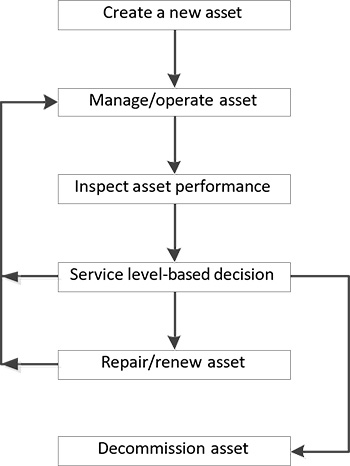
Every asset within the network is subject to deterioration over its lifetime. The key to managing this deterioration is to set service levels for those assets although practically this is done to groups of similar assets. Looking at the lifecycle diagram above, part of the process involves a decision point where the performance of an asset is compared against the agreed service levels for that asset type. The decision on whether to perform some action on the asset depends on the comparison.
There are four outcomes of the decision process:
- The asset is below the service level parameters and therefore has no action taken.
- The asset is decommissioned.
- The asset meets or exceeds the levels for reactive maintenance which is carried out within documented timescales.
- The asset meets or exceeds the levels for planned maintenance and is added to the process of long-term programming. Note that this does not preclude any reactive maintenance occurring.
The service levels for the various asset management groups are included as part of their associated asset management plans along with supplementary documentation such as the highways safety inspection manual.
Effective works programming
The delivery of the works programme is the tangible outcome of the asset management planning process. The programming and delivery of works should align with the asset management strategy and meet the performance targets.
The most effective use of the funding available to the highways service is dependent on having a long-term strategic view of the highway infrastructure. Our approach to lifecycle planning allows us this view and it is this which provides the building blocks of works programming or as it is known in North Yorkshire, the capital programme.
The creation of the various prioritised asset programs depends upon the specific asset class but will consider the following criteria:
- asset condition information from the various surveys across the asset management spectrum although in some cases, the asset information will be as a result of a safety inspection – such as with bridges or Vehicle Restraint Systems
- the location of the asset specifically the frequency of its usage or in the case of carriageways its category
- local knowledge which can be gleaned from a general appreciation of the area or feedback from stakeholders
- other specific asset information such as its contribution to portions of the highways infrastructure asset management policy for examples, key to the growth of a particular area
The resulting programme generated covers a three-year period with an additional two years indicative. Such a long-term approach allows not only for a level of certainty around funding but the ability to react to situations including:
- additional or reduced funding
- flexibility around scheduling
- issues with resource availability
Key facets of the capital programme are:
- frontloading the schemes to ensure that budgetary control is consistent and minimising a Q4 rush to spend budget
- looking to join schemes by types and/or geography where possible to provide the following benefits:
- minimising the disruption by carrying out work on one visit
- provide economies of scale either through the term provider or through framework contracts
Our enablers to a successful asset management system
Governance
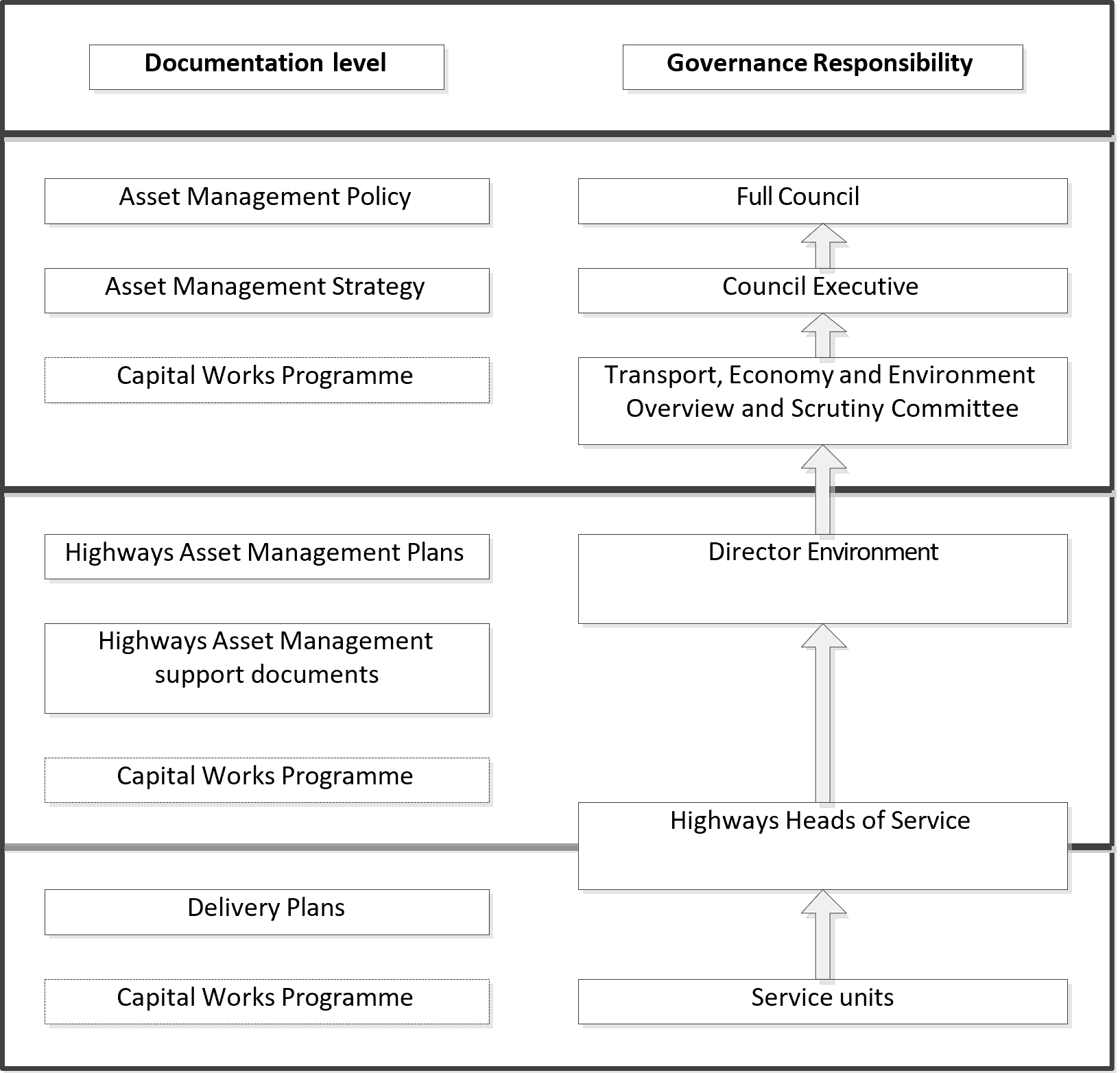
A governance structure has been put in place to enable both effective and appropriate scrutiny of the asset management framework. The diagram below shows the levels.
Policy and strategy
New policy and strategic documentation are signed off at council level after a process that includes our executive members, the Transport, Economy and Environment Overview & Scrutiny Committee and the highways senior team. Additionally and not shown on the diagram for brevity, the corporate management board are consulted. This ensures that there is consistency in the asset management framework at a strategic level with our overall vision. Updates and refreshes to the document that do not involve substantial changes to policy and strategy will be approved by the corporate director of environment in consultation with the executive member for highways and transportation.
Asset management plans and support documents
Overall governance of the asset management plans and support documentation rests with the corporate director of environment in consultation with the executive member for highways and transportation. This devolved approach is made possible due to the hierarchical way in which the framework operates. This devolvement allows for non-policy/non-strategic decisions on specific asset groups to be taken in a more agile fashion.
Operational delivery documentation
Operational management of the assets within the framework plans is generally governed by operational teams with support from internal highways and transportation teams and our maintenance and professional services partners. Where necessary the highways heads of service provide sign off.
The capital works programme
The overall capital works programme is signed off at council as part of the capital plan process. From that point onwards governance is devolved to one of three decision bodies depending on the requirements:
- The detailed capital programme and any subsequent additions and deletions from the programme require approval from the corporate director environment in consultation with the environment executive members, provided that these approvals stay within the limits set within the capital plan.
- Significant variations to schemes already within the programme are approved by the highways heads of service
- Other variations to schemes already within the programme are managed within the highways teams.
Performance management
As part of the overall asset management framework, the performance management is described in two separate areas within this strategy:
- strategic performance management measures the overall delivery of the service and relies on the service plans and single scores
- operational measures look at combinations of assets and groups of assets and how they perform and are described in a separate section of this document. These are described below:
Strategic performance management
The strategic performance management of the asset management framework is primarily through the use of service planning that sets levels of service supported by performance targets and measures.
Quarterly monitoring of the service plans are in place, providing visibility of the service performance to senior highways managers and reported through the corporate process to other stakeholders including our management board and members. Ultimately the reports are published for anyone to view if desired.
This is a cyclical process where service levels and targets are reviewed as part of a process of continuous improvement.
Operational performance management
Asset information forms a key part of the operational performance monitoring within the highways service and this management. The data within the asset management systems serves as the source for a variety of performance-related outputs. These reports form the basis for several key measurements within the highways service:
- Feeding into the lifecycle process – the performance of the assets over time is used as part of the whole lifecycle process that ultimately leads to the creation of the long term programme of works. This process is cyclical, embedding a level of continuous improvement in the service.
- Dashboards and other performance management work such as monitoring the effectiveness of the various investment strategies.
- Statutory returns to central bodies and other services. The condition indicators for asset groups form the basis for our statutory returns.
- Contractor and staff performance management.
Performance management of the capital works programme sits in both the strategic and operational areas with the operational financial information used to highlight issues with specific schemes.
Asset management systems
Asset data are of little value without the means to store, access and update the information. To support the key deliverables of the service, asset information needs to:
- be easily maintained for accuracy
- provide the basis for informed decision-making
- facilitate communications with stakeholders
- support the management of statutory requirements
- support continuous improvement
The primary location for North Yorkshire’s highways service asset information is Aurora which is a single commercial off-the-shelf product from Symology. The system is GIS based and provides the starting point for both current and historic asset information.
As an off-site managed system, the technical management is through a third party however a dedicated team of asset engineers provide the operational service. Data information contained within the system includes the following.
- asset information
- location details
- current and historic condition information
- work orders
- third party claims
- inspection schedules
- defects and associated maintenance
- customer requests and associated responses – the customer module with automated links into our central customer relationship management product
To facilitate a smoother path for customer access to asset information a number of the asset groups’ data are available to the general public for the purpose of fault reporting. Map-based, this allows our customers to report faults with certain asset groups through a portal based interface. The interface works two ways to provide automatic updates on call progress.
We recognise that there are occasions where a one-size-fits-all is not achievable and so outside of the primary asset management system, there are other asset groups that have requirements that need a dedicated system. Asset groups such as structures and traffic signals have their own dedicated systems through which they perform exactly the same processes.
We continually work alongside our system providers to look to augment the functionality of the asset management system to enable a greater centralised approach and an increased effectiveness of the system.
The highways asset information management plan describes the high-level requirements for the management of the assets. The asset management system is, in addition, the core of the operational performance management function.
Risk management
We have a corporate risk management approach which includes dedicated management of the high-level risks for each of the service areas across the organisation. Within highways and transportation these high-level risks are managed within the service areas reporting regularly through the corporate process.
Our approach to risk management is predominantly influenced by our statutory requirements as set out in various legislation. Leading on from this is the importance of being able to provide a robust section 58 defence against third party claims and the significant documentation around our risk-based approach to highways maintenance is proof of our commitment.
Risk based approach to asset management
The discipline and process of a risk-based approach to managing assets has increased significantly in all sectors within the last decade. Risk-based asset management has shown itself to be effective for asset-intensive systems, not necessarily by reducing risk, but by using risk to balance the operational performance of the assets against the asset life-cycle cost thereby creating a greater strategic overview of the asset lifecycle.
Expenditure on assets can be rationalised by using an assessment of what risk exposure is acceptable by varying stakeholders. Risk based asset management addresses the following critical issues as a minimum:
- safety of the network and liability for accident
- asset loss or damage
- service failure or reduction
- operational
- environmental
- financial
- contractual
- reputation
We, as part of continuous improvement continues to develop its approach to risk based asset management in accordance with best practice such as ISO 55000.
Inherent Risk Approach
Our approach to risk management is consistent across all the highways service, however, can be described within the following three separate areas:
- Corporate and the strategic network: The overall highways service has a number of entries on the corporate risk register including those specific to highways assets such as drainage, maintenance of the network and major network incidents. These are reviewed bi-annually to ensure that the overall assessment is still valid and that the risk reduction actions are kept current. The strategic network was initially formed from the critical routes as part of the winter maintenance function, however, has expanded to include those assets that support the county’s key strategic and service delivery locations. Given our ambition for economic growth then this strategic network will be regularly reviewed to ensure that it continues to support the council plan.
- Inspections: The inspection regime for all highways assets is described in the individual asset management plans and the highways safety inspection manual. The primary risk factor around inspections is usage of the assets and we carry out inspections frequently on the busier areas of the network; and
- Reactive maintenance: As with planned inspections, each of the highway’s asset types has an associated risk rating as set out in their respective asset management plans and the highways safety inspection manual. These describe the potential risks of a particular asset failing to perform to its expected level for example, a carriageway pothole, loose footway slab or blocked gully. This risk is based on a matrix measuring the probability and impact of such an event:
- Probability is the chance that an event with an asset will have an impact on someone or something. Essentially a problem with an asset on a busier part of the network is more likely to have an impact than one on a quiet part.
- Impact is the level of potential damage that a problem with an asset can have on someone or something.
The combination of these two measurements, based on a scale of 1 to 5, gives an overall risk rating which translates into whether there is a response and if so what the timescale is. The risk factors are regularly reviewed and changes are made where circumstances require it for example, a recent change in the risk factors on parts of the highway used by cyclists.
Formal adoption
This updated document was approved by the executive member for highways and transportation on 22 July 2026.
Highways and transportation